

Disclaimer: This blog post is purely informational and not intended to give medical advice. Any personal diet or nutrition decisions should be discussed with your personal health care team and/or a Registered Dietitian. There was no artificial intelligence or ChatGPT utilized in creating this post. All words are my own except where cited references are used.
When it comes to managing blood sugar or just eating a balanced diet in general, being able to understand and use the Nutrition Facts label on a packaged food item is beneficial in understanding how that food will affect your body and can take the guess work out of counting carbohydrates, fat, or protein.
Nutrition labels in the United States are a legally mandated requirement on FDA (Food and Drug Administration) approved foods [1]. The label must show serving size, Calories, macronutrients aka fat, carbohydrates, and protein, along with cholesterol, sodium, vitamin D, calcium, potassium, iron, and percent daily values of each of those nutrients. The decision as to what is specifically called out in the Nutrition Facts is based on nutrients Americans generally need more of (dietary fiber, vitamin D, calcium, iron, and potassium) or generally need less of (saturated fat, cholesterol, and sodium) to promote health [2].
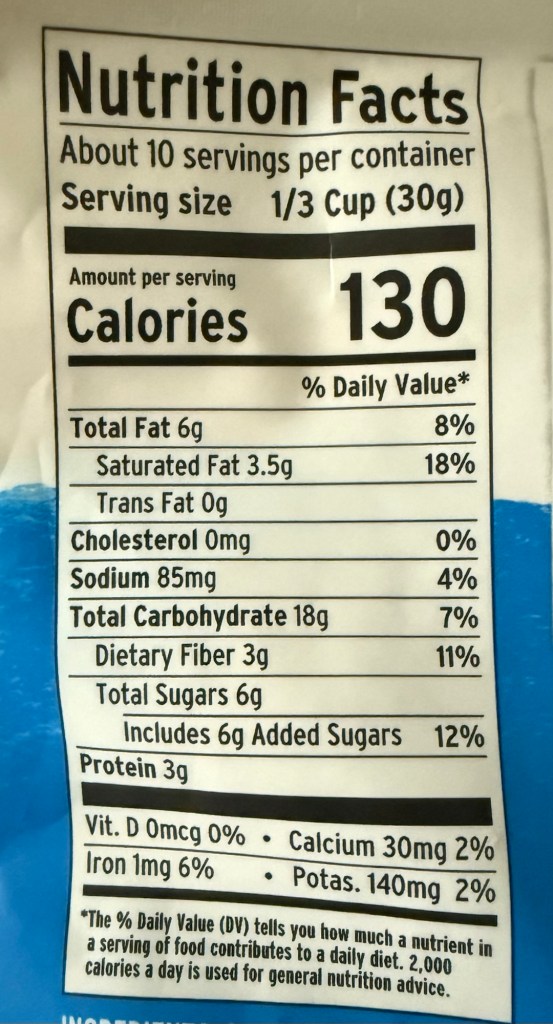
Serving Size
The serving size reflects the amount that people generally eat or drink and is not necessarily a recommendation on the amount you specifically should eat or drink [2]. This is the quantity of the food item for which the nutrition facts are for. If more or less than the serving size is consumed, the amount of nutrients would need to be multiplied or reduced accordingly. The serving size is standardized to cups or pieces followed by the metric amount, usually in grams [2]. In this example, a serving size is 1/3 cup or 30g.
Quick Tip: Grams for weight of the food serving is more accurate than volume measurement (cups or pieces). For example, if you pour an inconsistently shaped food item like potato chips into a measuring cup, you would get a different amount each time depending on the size of the chips and how they fall into the cup. If you measure the chips by weight on a food scale, the amount in grams would be consistent every time regardless of chip size keeping your serving size consistent and an accurate reflection of what is on the nutrition label per serving.
Calories
Calories are a unit of measure that quantifies the amount of energy in the food from fat, carbohydrates, and protein as this is what the body metabolizes for energy so the total Calories, 130 in this example, are coming from the fat, carbohydrates, and protein in the food. Vitamins (Vitamin D), minerals (Iron, calcium), and electrolytes (sodium, potassium) are key for bodily functions but contain no energy value aka have no Calories associated to them.
A 2,000 Calorie diet per day is noted on the food label as a rough estimate of a diet that could apply to a majority of individuals. However, this does vary person to person based on activity level, health conditions, and age, among other variables.
What is a Calorie? 1 calorie (lowercase “c”) technically defined is the amount of heat needed to raise the temperature of 1 gram of water by 1 degree Celsius. 1 calorie reflects a very small amount of energy so energy content is usually expressed in 1,000 calorie increments which equals 1 kilocalorie or 1 Calorie (with a capital “C”). In summary, a calorie is a unit of measure to express the amount of energy in food with a kilocalorie equaling 1,000 calories noted as kcal or Calorie [3].
Fat
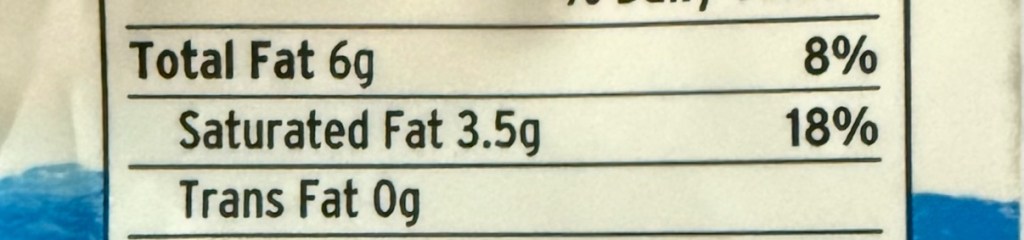
Total Fat is the first macronutrient listed below the total Calories. There are different types of fat: saturated, unsaturated, and trans. The saturated fat and trans fat are broken out below the total fat. In this food item, there are 6 grams of total fat with 3.5 of those grams coming from saturated fat. Since the trans fat is 0 we can assume the remaining 2.5 grams are coming from unsaturated fat, but it is not required that unsaturated fat is called out on the nutrition label.
Now, back to the total Calories being made up of the Calories from fat, carbohydrates, and protein. 1 gram of fat is 9 Calories [3]. If we take 9 times the 6 grams of total fat that means 54 of the total 130 Calories in the serving size are coming from fat.
What is Fat? Fat = Lipids and lipids come in many varieties used for energy and many chemical and physiological functions in the body like nutrient absorption, cell structure (fats make up the cell membrane), and hormone production. We see lipids broken into 3 main categories of saturated, unsaturated, and trans based on form and function. Saturated fats are solids are room temperature like meat and butter, unsaturated fats are liquid at room temperature like oils, and trans fat is artificially created fat found in processed foods [3].
Carbohydrates
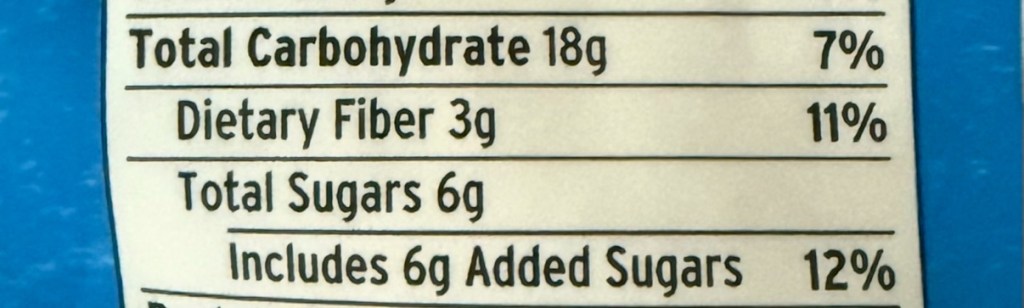
The next macronutrient listed on the label is Total Carbohydrate. 1 gram of carbohydrate is 4 Calories [3] so if we take the total 18 grams times 4 then 72 of the 130 total Calories per serving are coming from carbohydrates.
Fiber is a carbohydrate found in plants that unlike starch is not digested or absorbed in the human small intestine. The 3g of dietary fiber are contributing to the overall 18g of Total Carbohydrate. Fiber is classified as soluble (dissolves or swells in water) or insoluble (remains relatively unchanged through the digestive process) [3]. Soluble fiber can be broken down (fermented) by bacteria in the colon creating a gel like substance slowing digestion and delaying absorption of carbohydrates which helps prevent blood sugar spikes. Insoluble fiber provides “bulk” to stool and keeps the intestines happy by promoting growth of beneficial bacteria. This is why foods labeled as Keto friendly are high in fiber for low net carbohydrates because most of the Total Carbohydrates are coming from fiber. This is also why people with diabetes may subtract the the grams of fiber from the Total Carbohydrates when determining how much insulin to take for that food.
Total Sugars is the grams of sugar occurring naturally in the ingredients of the food item such as milk or fruit [2]. For example, if banana was part of the ingredients, there is sugar naturally occurring in a banana so that would be considered as part of the total sugars and contributing to the carbohydrate count of the food. This food item has 6g of naturally occurring sugar contributing to the overall 18g of Total Carbohydrate.
Added Sugars is the amount of sugar added to the food during processing that is not naturally occurring. These sugar types would be listed in the ingredients list. This food item contains 6g of added sugars contributing to the overall 18g of Total Carbohydrate.
You may have noticed that the 3g, 6g, and 6g do not add up to the 18g of Total Carbohydrate. This is because starch or complex carbohydrates do not have to be listed separately so we can assume the remaining 3g are coming from complex carbohydrates.
What is a carbohydrate? Carbohydrates are groups of compounds produced primarily by plants. These compounds are sugar molecules. Your simple carbohydrates consist of one or two sugar molecules like glucose, fructose (found in fruit), lactose (found in dairy products), or sucrose (table sugar). Complex Carbohydrates have 3 or more sugar molecules like raffinose and stachyose (found in legumes and cruciferous vegetables) or starch (found in potatoes and grains). Simple carbohydrates affect your blood sugar more quickly because there is minimal digestion that has to occur before those molecules can hit your blood stream while complex carbohydrates have multiple chemical bonds that have to be broken down before the sugar is in a form that the body can use. Glucose is the most abundant sugar in the body. It is the body’s primary energy source, the only source of energy for red blood cells, and the preferred energy source of the nervous system [3].
Protein

The third and final macronutrient listed on the label is Protein. 1 gram of protein is 4 Calories [3] so if we take the 3 times 4 Calories, 12 of the 130 total Calories per serving are coming from Protein.
Food marketing really likes to advertise that foods are high in protein, but for a food to truly be considered high in protein, 20% or more of the total Calories should be coming from protein or a rule of thumb can be if there are 10g per 100 Calories [4].
What is Protein? Proteins are complex molecules made up of smaller subunits called amino acids. The body needs 20 different amino acids to make all the proteins it requires to function. 9 are considered essential as they must be consumed in your diet as the body cannot make them while the other 11 are considered nonessential because the body can produce them. Proteins serve a large number of functions in the body such as the make up of the basic structure of tissues, enzymes for digestion, movement in muscles, ligaments, and tendons, transportation of substances across cell membranes, hormones and cell-signaling, regulation of pH and fluid balance, in addition to also being an energy source [3].
Daily Value
The Daily Value (DV) is the percentages listed at the end of a nutrient line. These percentages are based on a 2,000 Calorie a day diet and shows how much a serving of the food item contributes to a total daily diet. It is meant to give an idea of if a food is high or low in a nutrient. A general guideline is 5% DV or less is low in a nutrient and 20% DV or more is high in a nutrient [2]. These percentages can be used to compare nutritional value across food items and provide a guideline for eating a balanced diet.
Ingredients
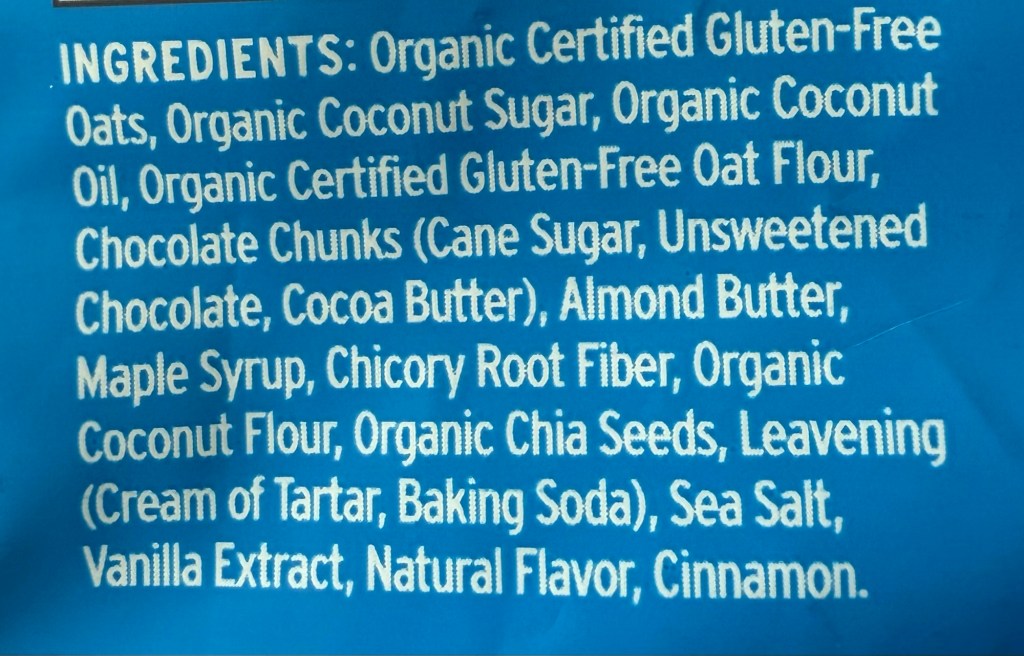
Last but not least, the ingredients list which is fairly self explanatory in that it is a list of all the ingredients in the food. However, a key note is that this list is required by the FDA to be listed in descending order of quantity of that ingredient. This means the first ingredient listed is what is most abundant in the food item, so Oats in this example, and listed last is what is least abundant in the food item, cinnamon in this example. This can be helpful to conceptualize quantity of sugar in a food as seeing “6g” may not mean much conceptually but if you see sugar listed as the second ingredient vs. the last ingredient it gives you an idea of how much sugar really is in the food for how it may affect your blood sugar.
A Few Tips if Living with Diabetes
In summary, here are somethings to keep in mind in how using the Nutrition Facts on a packaged food item can make living with diabetes a little easier. I’m calling them the “4 M’s”
- Measure! – I know it’s hard but don’t eat directly out of the bag or box or eyeball a handful. Measure out a specific amount! All you have to do is measure the amount and the math for calculating carbs is done for you. Tips to help with this…keep a food scale on your counter so you can see it and it’s easily accessible and put all packages in your pantry or cabinets with the nutrition label side facing outward so you see it when grabbing that food item.
- Multiply – If you eat more than 1 serving as specified on the package, don’t forget to multiple that based on how many servings you are eating.
- Make Up (of the Carbohydrates) – if a food item has a majority of its Total Carbohydrates coming from Total Sugars or Added Sugars, be conscious that it may raise your blood sugar faster since those are the simple carbohydrates. If there is a large amount of fiber in the food, it may need to be deducted from the total carbohydrates for insulin dosing.
- Make Note (of the ratio of fat and protein to carbohydrates) – If the amount of fat and/or protein is close to or more than the carbohydrate amount, your body will digest that food slower meaning a slower rise in blood sugar or a delayed rise in blood sugar.

A Final Note…
If you noticed throughout this post I never mentioned anything related to the food nutrients as being “good” or “bad.” This is because there are no bad foods. Even a “good” food could be bad if over-consumed. The key part to any diet is balance and moderation. A diet is highly individualized based on culture, geographic location, socioeconomic status, health conditions, medications, age group, etc. I’d highly encourage you to work with a Registered Dietician (RD) if you are looking for an individualized diet recommendation or plan to fit what is best for you.
There is a lot of nutrition information (and mis-information) out there, but I hope the nutrition basics shared here are helpful in your nutrition journey. Feel free to drop your thoughts and questions in the comments below!
“So whether you eat or drink or whatever you do, do it all for the glory of God.” – 1 Corinthians 10:31

Written by Katherine LoPorto, MS
References
- FDA. (2024, March 5). The nutrition facts label. U.S. Food and Drug Administration. https://www.fda.gov/food/nutrition-education-resources-materials/nutrition-facts-label
- FDA. (2024, March 5). How to understand and use the nutrition facts label. U.S. Food and Drug Administration. https://www.fda.gov/food/nutrition-facts-label/how-understand-and-use-nutrition-facts-label
- McGuire, M., Beerman, K.A., (2018). Nutritional sciences: from fundamentals to food (3rd ed.). Cengage Learning
- Parker, T. (2025, October 23). Protein: How much do you need?. British Heart Foundation. https://www.bhf.org.uk/informationsupport/heart-matters-magazine/nutrition/protein
 With Diabetes in Mind
Leave a comment