
This blog post is sharing my own personal experience in using the Omnipod 5 insulin pump during pregnancy. This is not affiliated to Insulet Corp. in any way. Please discuss all blood sugar management and insulin therapy options with your personal diabetes care team, but as always, I hope this provides information to help with what questions to ask to inform your own diabetes management.
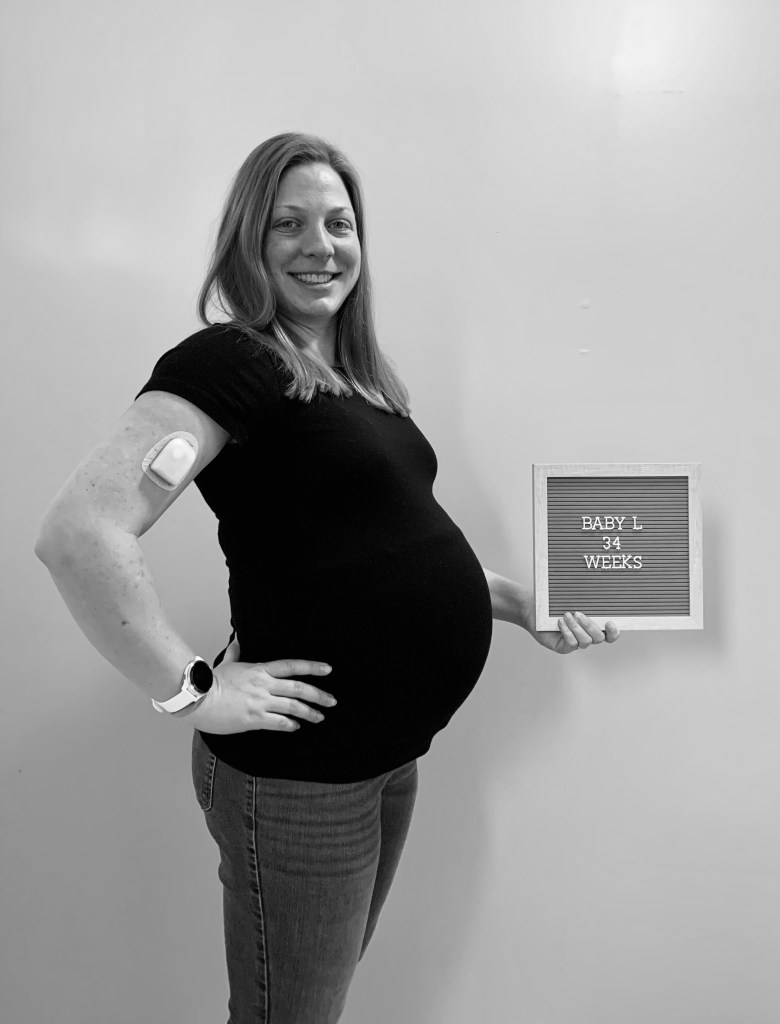
My quick overall summary of using the omnipod 5 during pregnancy: Good, but not great, especially in the later half of pregnancy. Here are my pros and cons of why. I’m starting with the cons as feel it helps provide context to the pros.
The “Cons”
1. Can’t use the SmartAdjust technology which is the auto mode that will automatically adjust insulin every 5 minutes to bring your glucose value to your customized target glucose [1]
Pre-pregnancy auto mode kept my blood sugars in the 130-150 mg/dL range even at the lowest target setting of 110 mg/dL. These ranges aren’t low enough to support the American Diabetes Association’s recommended pregnancy target ranges of below 140 mg/dL an hour after a meal and below 120 mg/dL two hours after a meal [2]. Page 9 of the Omnipod 5 User Guide does state a warning that the SmartAdjust technology should not be used in pregnant women as it has not been evaluated in this population. This was something I was aware of going into pregnancy from my endocrinologist and I also mention this in my first trimester of pregnancy blog post. None the less, the SmartAdjust technology is the selling feature of the Omnipod 5 so it was a bummer not being able to use it during pregnancy which is time where the more help you can get in managing blood sugars the better.
2. One pod holds a maximum of 200 units of insulin
While this lasted me the 72 hours (an omnipod pod expires after 72 hours) throughout the first part of pregnancy, as my insulin needs increased during pregnancy, where I’ve ended up in my third trimester using about 120 units a day, a single pod can no longer last me the 3 days or even 2 at that. At the end of my second trimester I started supplementing my omnipod insulin administration with insulin pen injections for meal time boluses to stretch my omnipods to their third day of use.
3. 30 unit maximum bolus setting
While 30 units seems well within reason for a maximum bolus amount, my morning carb to insulin ratio by the end of pregnancy was 1 unit to 2 grams and my evening ratio was 1 unit to 3 grams so 60 grams of carbs takes me to that limit. This is another reason why I started using injections for meal time boluses. A way around this would be to split my boluses into two, but this further increases the time it takes for that insulin to start working which leads me to the next point.
4. Delivers 0.05 units at a time during a bolus
This means it takes 10 plus minutes to deliver a larger bolus adding to the time it takes for that insulin to go into effect when already dealing with insulin resistance/delayed response time in the later half of pregnancy. It would take almost 15 minutes to deliver a 20 unit bolus and even more time would be added to this if I was needing to do an additional bolus to cover my full bolus amount due to the maximum bolus setting. This is a third reason I went to injections for boluses as I could receive the entirety of my bolus in seconds vs. minutes and could use a rapid acting insulin (Fiasp) to help combat delayed insulin absorption. I use Humalog insulin in my Omnipods and the 15-20 minute time frame for that insulin to start working turned into double that throughout my pregnancy.
5. Cannot do another bolus while an extended bolus is in progress (manual mode only)
If I eat something higher in fat where I may do an extended bolus of let’s say 4 hours, I cannot do another bolus in that 4 hour time frame. On the old Omnipod, I could do another bolus in that time frame if I ate something. Now granted, eating something after that extended bolus could impact the way the macronutrients of the food from that extended bolus are digested and may change if that extended bolus is still needed which is why I believe this setting exists. That being said, I have ended up using an increased temporary basal rate in place of an extended bolus due to this functionality.
The “Pros”
The Omnipod technology still worked great during the first part of my pregnancy when my daily insulin usage was still in my pre-pregnancy range. I did miss using the auto mode for preventing lows, but feel my manual basal rates were pretty spot on for an easy transition from auto to manual mode. It was also vary handy being able to create different basal rate profiles and the ability to set different carb to insulin ratios throughout different times of the day. Even after I switched to using injections for meal time boluses, it was still nice to have the basal rate flexibility compared to if I was using injections only (MDI) and the Dexcom integration for correction boluses and decision making. I would still use my omnipod controller to calculate the amount of insulin I would need to bolus using an injection. The tubeless aspect of the pump was also nice as felt there was more flexibility in site locations as the body changes throughout pregnancy.
Overall, the Omnipod was still a great diabetes management option to use during pregnancy, but once I was using more than 60-70 units per day, it lost some of its benefit. If I would not have been able to supplement use of the Omnipod with injections, I do not think I would have had as good of blood sugar control during my third trimester. I also would have had insurance headaches as I would either run out of Omnipods before I could refill my prescription due to not being able to use them the full 3 days before running out of insulin or I would have to fight trying to get an updated prescription to increase the quantity of Omnipods I could receive. Both options would take time and headaches and I didn’t want risks to not having the diabetes supplies I needed to maintain blood sugar control during pregnancy. It was easier to get an additional prescription for Fiasp insulin pens than to try and modify my existing Omnipod prescription.
Another pro is that I am looking forward to using auto mode again post delivery as I hope it will help with managing the wild ride of what insulin sensitivity will be like come the postpartum hormone changes.
If you have any questions about my experience in using the omnipod 5 during pregnancy or not, I’d love to chat! Thanks for reading.
References
1. Omnipod 5 User Guide: https://www.omnipod.com/sites/default/files/Omnipod-5_User-guide.pdf
2. Nuha A. ElSayed, Grazia Aleppo, Vanita R. Aroda, Raveendhara R. Bannuru, Florence M. Brown, Dennis Bruemmer, Billy S. Collins, Marisa E. Hilliard, Diana Isaacs, Eric L. Johnson, Scott Kahan, Kamlesh Khunti, Jose Leon, Sarah K. Lyons, Mary Lou Perry, Priya Prahalad, Richard E. Pratley, Jane Jeffrie Seley, Robert C. Stanton, Robert A. Gabbay; on behalf of the American Diabetes Association, 15. Management of Diabetes in Pregnancy: Standards of Care in Diabetes—2023. Diabetes Care 1 January 2023; 46 (Supplement_1): S254–S266. https://doi.org/10.2337/dc23-S015; https://diabetesjournals.org/care/article/46/Supplement_1/S254/148052/15-Management-of-Diabetes-in-Pregnancy-Standards

 With Diabetes in Mind
Leave a reply to Third Trimester of Pregnancy with Type 1 Diabetes – With Diabetes in Mind Cancel reply